Wednesday, 27 March 2013

Out and About in San Diego

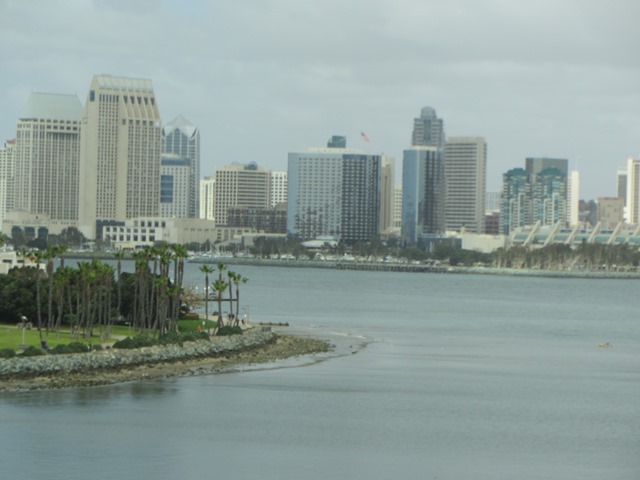
After our drive down the coastline Terry next introduces us to the city of San Diego.

We drive to Balboa Park over the Cabrillo Bridge, an historic pedestrian and motor vehicle bridge providing access to Balboa Park and the uptown area of San Diego.

The bridge was built for the Panama-California International Exposition of 1915 which was held in Balboa Park; it crosses the Cabrillo Canyon and carries El Prado, the park's main street.

There is a great view of the bridge from the Cabrillo Freeway (State Hwy 163)  located on the floor of the canyon.

When you drive across the bridge, the view entering Balboa Park is stunning!


View from State Hwy 163


Balboa Park is the nation's largest urban cultural park. It covers 1,200 acres and is rich with museums, spanish colonial-style pavilions, art collections, performance spaces, glorious gardens and the famous San Diego Zoo.

We continue our drive on to Coronado over the Coronado Bay Bridge. We pass the Hotel Del Coronado, locally known as the 'Del'; then a drive through the Naval Base where Terry spent some years. On for lunch at Jalisco Cafe in Imperial Beach - an authentic Mexican restaurant.  Terry orders for us ...  small dishes to give us a range of tastes, and Mexican beer. It is all delicious!


Then we are on the road again, now into downtown - Broadway, the Gaslamp Quarter, Seaport Village, the Convention Centre, Old Town and Little Italy.

We are looking forward to taking the Trolley and exploring further. We were last in San Diego in 1987 more than 25 years ago. It is wonderful to be back.

Junipero Serra Museum


In the late 1700's Spanish explorers established missions throughout Southern California - several of the missions still exist today. Mission San Diego de Alcala, known as the 'Mother of the Missions' was the first of 21 missions to be built in Southern California.
On 16 July 1769 Father Junipero Serra, a Spanish Franciscan missionary and the soldiers of Spain dedicated the Mission San Diego de Alcala.

The Museum was built on the hill known as Presidio Park where the first mission and presidio (fort) was built. The architecture of the museum resembles that of the early missions.

We are struck by the number and size of the eucalyptus trees that are prevalent throughout San Diego. We can smell their leaves!!
Eucalyptus trees were introduced into California in the 1850's by Australians during the California Gold Rush. A similar climate encouraged them to flourish. There are some magnificent specimens especially around Balboa Park

Terry finishes our tour off with a drive into the country around the area known as El Capitan. The El Capitan Reservoir is in the hills east of Lakeside; it is formed by the El Capitan Dam on the San Diego river.


Its very nice country. Only a few days ago there was  snow on the ground!


San Diego!!

We have been in San Diego for almost 3 weeks, staying at the San Diego RV Resort in La Mesa.

We have had such a great time.  Thanks to Terry and Janice we have seen a lot of the city and surrounding areas ... we have been able to get our bearings and stop for a while.

While in Yuma we bought an American flag ... it seems
 appropriate and we fly both flags with pride.
We had the service on the RV.
A new part was needed  for the ice maker water line which had to be ordered in. We went back to the RV Service Centre a couple of days later and had that work done;  a replacement water line and water valve.

We are good as new and can't speak highly enough of the service we received.

Most importantly we can make Margaritas again, although after tasting Terry's Margaritas we need to do a bit more experimenting with the recipe! Sounds like fun!


Pacific Ocean
On our first day in San Diego Terry takes us touring. We drive north and out to the coast at Del Mar and ...  there's the Pacific ocean.
What a wonderful sight. We feel  close to home. Well - with some imagination or is this the Royal  'we'? I certainly have a lump in my throat!

We drive down the coast, passing by Torrey Pines Golf Course, the nation's foremost municipal golf course. Situated on top of cliffs  towering above the Pacific ocean, it is named after the Torrey Pine, a rare tree that grows in the wild along this local stretch of the coastline.

Then on to La Jolla (pronounced 'la hoy ah'), known as the jewel of San Diego. La Jolla, a hilly seaside community occupying 7 miles of curving coastline,  features luxury homes and upscale shopping and ... beautiful beaches.

The 'village' of La Jolla


The Children's Pool
The Children's Pool, located close to down town La Jolla is a small cove protected by a concrete breakwater. It was originally built to create a safe swimming area for children but is now taken over by seals and sea lions who beach themselves on the sand with their young.

There are lots of seals all along the coast line lying on rocks basking in the sun.


We continue our drive down the coast through the coastal suburbs of  Pacific Beach, Mission Beach and Ocean Beach - a quintessential California surfing town with a 60's flavour.

Hang gliding area ... or a high jump if you are in the way?


And just to make sure 'y'all' remember that I came along for the ride, Terry contributed some photos. Thanks Terry!


We had lunch at Mitch's Seafood on San Diego Bay in the fishing neighbourhood of Point Loma overlooking the bay and the sports fishing fleet. A wonderfully understated cafe with fabulous food. We sat out on the deck; ate fish tacos and had a beer.  Pretty nice!

Then we were off again driving to the extreme end of Point Loma Peninsula where stands the Cabrillo National Monument, a statue of Juan Rodriguez Cabrillo the first European to set foot on the West coast of the US. On 27 June 1542 Cabrillo set sail north from Mexico, then called New Spain; on 28 September 1542 he entered what would become San Diego Bay. He continued north to the Bay which is today, Los Angeles. He claimed the whole of the area for Spain.

We climbed the Old Point Loma Lighthouse (yes there is a 'new' one). Fantastic views and lots of history. A second lighthouse was constructed below the Old lighthouse to overcome the problem caused by fog and ensure that the light could be seen.


A wonderful introduction to San Diego thanks again to Terry.
Art deco perhaps?


San Diego is defined by the sea. Extending to the border with Mexico, its coastline has 70 miles of magnificent beaches, rocky and high cliffs, coves and seaside resorts.


Cabrillo National Monument


San Diego is the 8th largest city in the US and 2nd largest city in California with a population of approximately 1.3 million.

It is the birthplace of California; known for its year round mild climate, natural deep water harbour, extensive beaches, long association with the US Navy and recent emergence as a health care and biotechnology development centre.

Naval Base San Diego - also known as 32nd St. Naval Station - is the largest base of the US Navy on the west coast of the US. It is the principal homeport of the Pacific Fleet.


Ocean Beach Pier


Friday, 22 March 2013

California here we come.


We cross the state line into California at 11am on 5 March and turn our watches back an hour - we are now on Pacific Time and 16 hours behind Perth ... and its only 10am!!

We refuel  in Yuma before we leave - we have heard that gas is so much more expensive in California. We get it for $3.67 a gallon.
We take I-8W, a straight highway pushing through mile after mile of dunes. We can see the Mexican border fence stretching out to our left - south of us. The border fence is not one continuous structure but a grouping of short physical walls that stop and then start again, secured by a 'virtual'  fence which includes a system of monitored sensors and cameras.


There is much controversy about how to secure the border with Mexico. The latest polls show a majority in favour of the border fence. However there are many ongoing problems including the fact that many die who attempt the crossing; there are environmental issues;  also landholding issues relating to  farming properties, Indian Nation lands and even urban areas; the removal of animals from their natural habitats -just to mention a few.


We stop at El Centro for a coffee and wifi. We have been out of contact for the week in Yuma, except by phone; the wifi was very poor in the RV park. I use the hotspot to check emails but even that was not good. Also being so close to the border with Mexico I was worried that my phone would pick up the Mexican service - which is strong - and I would find myself with a massive phone bill!

It is good to get good wifi connection in Starbucks!

El Centro a city in the far southeastern corner of California, is the largest American city to lie entirely below sea level - 50 feet below.
Nearby Algodones Dunes, the largest dunefield in the US, draws thousands of visitors each year, mainly for off road driving.

The Naval Air Facility 10 miles to the west  of  El Centro is where the Blue Angels have their winter training. The Blue Angels, the US Navy's flight demonstration squadron was formed in 1946.

Salton Sea, 30 miles to the north of El Centro was created by a  flood of the Colorado River in 1905. It is a shallow, saline lake on the San Andreas Fault. Its surface is 226 feet below sea level. It is 15 miles by 35 miles with an area roughly 525 square miles.


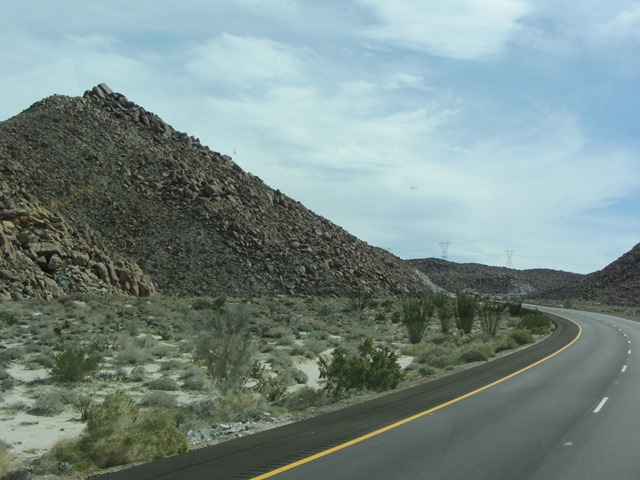
We are approaching mountains. We climb from below sea level to over 4000 feet. It is a good drive with spectacular scenery.
Lots of wind farms.
There is a border check point at the summit but we are waved on.Then we have a steep descent to El Cajon where we have the RV booked in for a service tomorrow.
We get a site at an RV park; Trevor has a swim. It is not as warm as Yuma but pretty nice.


The mountains take on a blue misty colour the higher we go, which makes them look softer.
The climb is steady but easy for          our wonder girl; she must be a female.


Off for a swim after the drive from Yuma.


Tomorrow we will have the RV serviced then drive on to San Diego only 22 miles away.

It is a month until  Kim and Mace and our granddaughter Finlay arrive in San Francisco for a 3 week holiday with us. This holiday has been long in the planning - since before we left Perth last July. We are well placed for their arrival and getting very excited.

Being in California will also give us the opportunity to catch up with Terry Rossknecht, his wife Janice and their family.

Terry is a brother of  Ron in South Dakota. We met him  in 1980 in Perth.  He was on the aircraft carrier the Kitty Hawk which came into Fremantle on R&R. Trevor met him at a service station on the corner of Reynolds Road and Canning Highway in Applecross. He (Terry) was looking to get his bike tire fixed; he was planning to bike to Yanchep to see the koala bears, a very long ride. Trevor talked him out of that and invited him home for a meal ... and the rest is history.

Terry was our introducion to the Rossknecht family. Over the last almost 30 years we have had some wonderful holidays in the US and have met many members of the Rossknecht family.

We are looking forward to seeing him again.